

System map
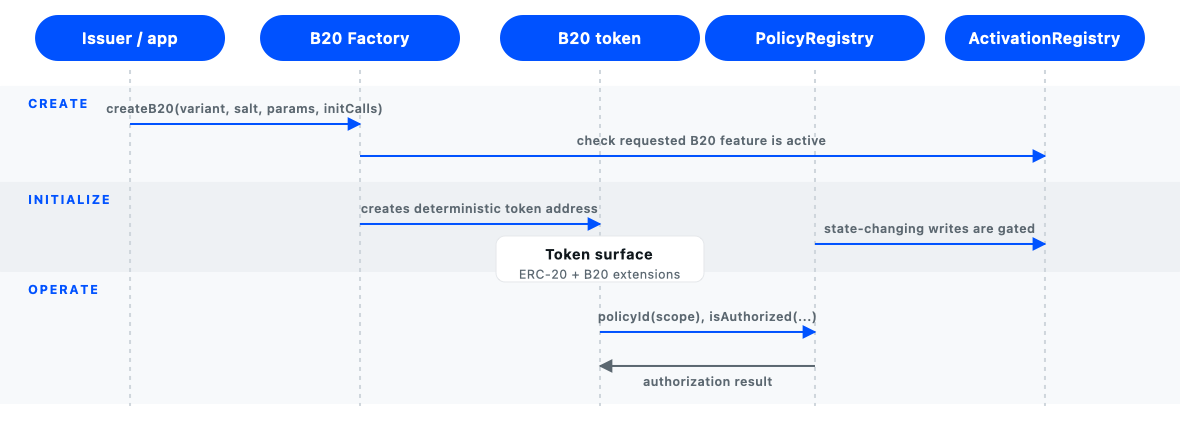
These addresses are identical on every network where B20 is active.
Activation gates
The ActivationRegistry is the chain-level feature flag surface. The factory checks activation before creating a token variant, and state-changing PolicyRegistry calls are activation-gated.PolicyRegistry read functions are always callable. Integrations can safely call
isAuthorized, policyExists, policyAdmin, and pendingPolicyAdmin without an activation write path.Address derivation
B20 token addresses are deterministic and include the variant byte:
Use
IB20Factory.getB20Address(variant, deployer, salt) to precompute the address and isB20 / isB20Initialized to verify it.
What precompiles change for developers
- Import interfaces from
base-stdinstead of copying ABIs by hand. - Use
StdPrecompileshandles for the factory and registries. - Do not expect explorer bytecode verification for token or registry addresses.
- Test with base-std mocks,
base-forge, orbase-anvilbecause stock EVM tooling does not know these precompiles by default.