> ## Documentation Index
> Fetch the complete documentation index at: https://base-a060aa97-docs-add-b20-spec.mintlify.site/llms.txt
> Use this file to discover all available pages before exploring further.
# Architecture & precompiles
> Understand the B20 precompile architecture, fixed addresses, activation gates, and deterministic token addresses.
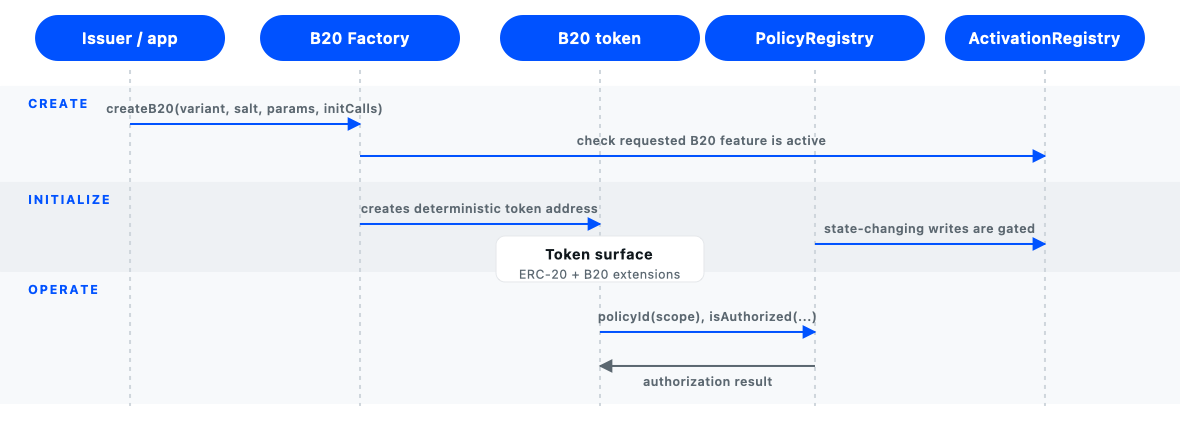
A B20 token is not a contract you deploy. It is a chain-native token surface implemented as a Rust precompile and created through the singleton B20 Factory. Solidity and offchain clients still call normal ABI methods, but there is no token bytecode to verify on an explorer.
## System map
 | Surface | Address |
| ------------------ | -------------------------------------------- |
| B20 Factory | `0xB20f000000000000000000000000000000000000` |
| ActivationRegistry | `0x8453000000000000000000000000000000000001` |
| PolicyRegistry | `0x8453000000000000000000000000000000000002` |
These addresses are identical on every network where B20 is active.
## Activation gates
The ActivationRegistry is the chain-level feature flag surface. The factory checks activation before creating a token variant, and state-changing PolicyRegistry calls are activation-gated.
PolicyRegistry read functions are always callable. Integrations can safely call `isAuthorized`, `policyExists`, `policyAdmin`, and `pendingPolicyAdmin` without an activation write path.
## Address derivation
B20 token addresses are deterministic and include the variant byte:
```text theme={null}
[10-byte B20 prefix][1-byte variant][9-byte keccak256(deployer, salt)]
```
You can identify a token's variant from the address without an RPC call by inspecting byte 10, zero-indexed:
| Variant | Byte | Address shape |
| ---------- | -----: | ------------- |
| Asset | `0x00` | `0xB200...` |
| Stablecoin | `0x01` | `0xB201...` |
Use `IB20Factory.getB20Address(variant, deployer, salt)` to precompute the address and `isB20` / `isB20Initialized` to verify it.
## What precompiles change for developers
* Import interfaces from `base-std` instead of copying ABIs by hand.
* Use `StdPrecompiles` handles for the factory and registries.
* Do not expect explorer bytecode verification for token or registry addresses.
* Test with base-std mocks, `base-forge`, or `base-anvil` because stock EVM tooling does not know these precompiles by default.
| Surface | Address |
| ------------------ | -------------------------------------------- |
| B20 Factory | `0xB20f000000000000000000000000000000000000` |
| ActivationRegistry | `0x8453000000000000000000000000000000000001` |
| PolicyRegistry | `0x8453000000000000000000000000000000000002` |
These addresses are identical on every network where B20 is active.
## Activation gates
The ActivationRegistry is the chain-level feature flag surface. The factory checks activation before creating a token variant, and state-changing PolicyRegistry calls are activation-gated.
PolicyRegistry read functions are always callable. Integrations can safely call `isAuthorized`, `policyExists`, `policyAdmin`, and `pendingPolicyAdmin` without an activation write path.
## Address derivation
B20 token addresses are deterministic and include the variant byte:
```text theme={null}
[10-byte B20 prefix][1-byte variant][9-byte keccak256(deployer, salt)]
```
You can identify a token's variant from the address without an RPC call by inspecting byte 10, zero-indexed:
| Variant | Byte | Address shape |
| ---------- | -----: | ------------- |
| Asset | `0x00` | `0xB200...` |
| Stablecoin | `0x01` | `0xB201...` |
Use `IB20Factory.getB20Address(variant, deployer, salt)` to precompute the address and `isB20` / `isB20Initialized` to verify it.
## What precompiles change for developers
* Import interfaces from `base-std` instead of copying ABIs by hand.
* Use `StdPrecompiles` handles for the factory and registries.
* Do not expect explorer bytecode verification for token or registry addresses.
* Test with base-std mocks, `base-forge`, or `base-anvil` because stock EVM tooling does not know these precompiles by default.